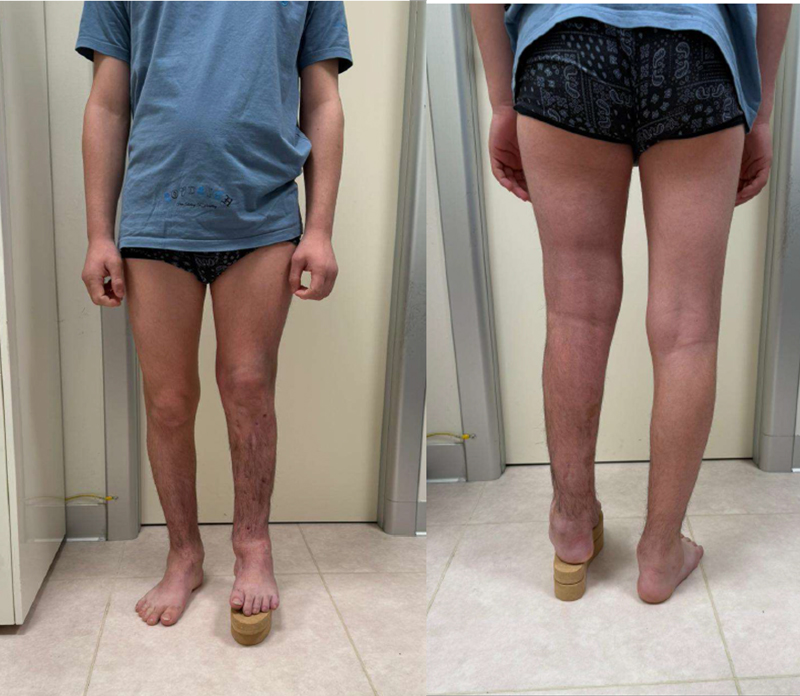
The treatment of limb length discrepancy requires centers that have experience and clear ideas on the subject. If one relies on centers without these characteristics, there is a significant risk of performing unnecessary radiographic or diagnostic tests and incorrect treatments.
OrthoChildren (Bologna, Italy): a center with experience in limb length discrepancy
Our center has considerable experience in this field and is one of the few Italian centers capable of handling both the simplest and the most complex cases.
Dr. Lampasi worked for years at the Rizzoli Orthopedic Institute (Bologna, Italy), gaining considerable experience in all congenital and acquired conditions that cause limb length discrepancy and their treatments. He was Head of Pediatric Orthopedics at Meyer Hospital in Florence, introducing treatment plans for these conditions to the hospital and performing (a first for the hospital) many complex procedures in this area (lengthening, correction with hexapodal external fixators, etc). For years, he has taught and provided information to various professionals in this field.
Dr. Lucchesi has been treating limb length discrepancy for years and has acquired significant experience in this field, thanks also to extended training periods with Dr. Alexander Kirienko, a leading expert in external fixation with the Ilizarov apparatus, and thanks to attending courses held by Prof. Dror Paley.
Treatment of limb length discrepancy: what to avoid?
The errors we encounter most frequently in this area concern:
- Unnecessary or inappropriate diagnostic tests: for example, tests for hemi-hypersomia in patients with hypoplasia
- Repeated or incorrectly performed X-rays: patients positioned incorrectly, without a lift, etc. This exposes children to unnecessary radiation. In our center, when necessary, the doctors themselves position patients for X-rays.
- Treatments with incorrect indications: for example epiphysiodesis in cases requiring lengthening
- Incorrect timing for operations: for example, epiphysiodesis performed too early or limb lengthening performed too late
Treatment of limb length discrepancy:: how to intervene?
Dealing with length differences requires experience and appropriate assessment schemes. Referral centers like ours have clear ideas and specific treatment plans. Furthermore, having experience with various types of treatments, they can more reliably recommend one treatment over another.
Treatment of limb length discrepancy:: when should it be treated?
- Minor length differences, less than 1 cm in difference, are not a cause for concern and generally do not require treatment.
- Differences of 1-1.5 cm can benefit from the introduction of a lift but above all they must be evaluated in children to understand whether they are developmental (i.e., they tend to increase) or if they remain stationary.
- Surgical treatment is generally considered when the length difference exceeds 1.5-2 cm
Treatment of limb length discrepancy:: when to intervene?
The timing of intervention is crucial and interventions are often performed incorrectly, either too early or too late.
Limb limb length discrepancy: what are the causes?
Possible causes include: congenital malformations (hypoplasia, hemimelia, etc.), developmental diseases, vascular problems, sequelae of infections, sequelae of trauma, neurological pathologies (cerebral palsy, etc.).
They do not only affect the lower limbs (femur-tibia) but can also affect the upper limb (humerus, radius, ulna).

Limb length difference: Is the problem the shorter limb or the longer limb?
It is essential to distinguish the cases in which:
- the pathology is due to a shorter limb: hypometria (for example due to hypoplasia, hemiplegia, growth disorder, etc.)
- the pathology is due to a longer limb: hypermetria (for example due to macrosomia or hemihypersomia)
Treatment of limb length discrepancy:: planning
Centers with experience in this field:
- they evaluate various aspects (patient’s age, underlying pathology, residual growth, etc.)
- make a prediction of length difference at the end of growth
- they consequently establish a treatment plan to recover the difference
Treatment of limb length discrepancy: what surgical interventions are available?
Among the options available:
- symmetric epiphysiodesis
- limb lengthening
- shortening of the limbs
Symmetrical hemiepiphysiodesis: what is it?
Hemiepiphysiodesis is generally reserved for minor length differences, approximately 2-3.5 cm. It is a minimally invasive procedure, with rapid functional recovery, which slows the growth of the longer limb.
It requires experience and careful planning to choose the best time to perform the procedure.
If performed too early it risks causing excessive shortening of the operated limb
If performed late, it risks not being effective

Limb lengthening: what does it mean?
For length differences greater than 3-3.5 cm, it is recommended to make up the length difference by lengthening the shorter limb. This can be done:
- via magnetic nails
- using external fixators
In these cases, it is also possible to correct any associated deformities (valgus, varus, etc). Please refer to the dedicated sheet.

Major length differences: how to deal with them?
In case of major length differences, over 10-15 cm, it is necessary
- establish a plan for repeated lengthening over time
- pay close attention to the morphology and stability of the surrounding joints and carry out adequate preparation using joint reconstruction procedures: SUPER-Hip, SUPER-Knee, SUPER-Ankle (see dedicated sheet)