


Congenital Femoral Deficiency (CFD) in children: how is it treated?
The treatment for Congenital Femoral Deficiency (CFD) must not only take into account the shortening of the bones but must consider all the pathological aspects mentioned in the fact sheet on Congenital Femoral Deficiency (CFD) (see).
Congenital Femoral Deficiency (CFD): general principles for treatment
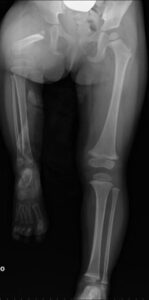
Given the extreme variability of the clinical presentations of Congenital Femoral Deficiency (CFD), the first and most important evaluation in severe cases is to decide whether the ultimate goal is to equalize the discrepancy or to walk with a prosthesis . The threshold beyond which reconstruction is not recommended varies considerably depending on the author. The Gillespie classification (see Congenital Femoral Deficiency (CFD) fact sheet ) can be helpful. The decision should take into account the foreseeable discrepancy, anatomical alterations (hip, knee), and the condition of the foot for possible future contact with the ground.
Goal: prosthesis?
In cases of severe Congenital Femoral Deficiency (CFD) where the ultimate goal is walking with a prosthesis, surgical procedures will serve to stabilize the prosthetic limb . Therefore, in cases where reconstruction is possible, osteotomies of the proximal femur or pelvis will be performed. In cases where reconstruction is not an option, hip arthrodesis will be performed. Other possible associated procedures to allow for a more stable prosthesis include: knee arthrodesis, Syme amputation, and gyroplasty .
Objective: reconstruction?
In less severe cases of Congenital Femoral Deficiency (CFD), generally when the expected shortening of the femur at full growth is less than 20 cm, a therapeutic program for limb reconstruction and lengthening is established. When designing and implementing a program, it is essential to consider the joint and muscle function of the limb.
Achieving length equalization without maintaining adequate joint function (especially the hip and knee) leads to poor functional outcomes. This is one of the main mistakes made in the past in the treatment of femoral hypoplasia.
The treatment plan for Congenital Femoral Deficiency (CFD) will include various procedures to be performed throughout growth. It must obviously also include any corrective or lengthening procedures in cases where there is also fibular hemimelia (see the relevant fact sheet).
For example, it may be decided whether to perform simultaneous femoral and leg lengthening . This procedure has the advantage of reducing the time needed to apply the external fixator, increasing the speed of recovery from shortening, but it has the disadvantage of placing greater stress on the muscles and structures of the limb, particularly the knee, which must be monitored with the utmost care.

Congenital Femoral Deficiency (CFD)in children: surgical interventions
Corrective procedures for Congenital Femoral Deficiency (CFD) mainly include:
- Hip Reconstructive Procedures
- Reconstructive procedures for the knee
- Lengthening interventions
- Hip Reconstructive Procedures
Before starting lengthening procedures for Congenital Femoral Deficiency (CFD), it is essential that any pathological conditions present at the hip level are corrected.
In cases of acetabular dysplasia, the inclination of the acetabulum is too vertical, and the forces produced during femoral lengthening can cause dislocation of the femoral head. For this reason, before proceeding with lengthening, it is necessary to correct the dysplasia with a pelvic osteotomy (Dega, Salter, etc.).
In case of varus of the proximal femur (coxa vara), similarly, the varus must be corrected by an osteotomy of the proximal femur.
These problems may be found in isolation in milder cases of Congenital Femoral Deficiency (CFD), or they may be found in more complex cases of severe deformities. In this case, surgical procedures simultaneously address all pathological aspects (coxa vara, acetabular dysplasia, hip deformities in external rotation and flexion, abduction contracture, possible failure of ossification/pseudarthrosis of the proximal femur, etc.) through a complex procedure, described by Professor D. Paley as the SUPER-Hip Procedure (see fact sheet).
It is generally recommended to perform these preparatory procedures early, at the age of 2-3 years. (See dedicated factsheet)
Reconstructive procedures for the knee
In patients with Congenital Femoral Deficiency (CFD), the knee can be affected in different ways (see the related fact sheet): valgus, flexion contracture, lateral patellar hyperpressure, instability due to agenesis or hypoplasia of the cruciate ligaments.
Depending on the alteration present, a corrective procedure will be necessary. While some problems can be corrected during growth, others are preferably addressed before lengthening procedures, such as preparatory surgery.
Knee instability is a fairly common problem in patients with femoral hypoplasia, often undiagnosed if there is insufficient experience with these conditions. This is an aspect that must be carefully considered. In cases of greater instability, the orthopedic surgeon may decide to reconstruct the ligaments before proceeding with lengthening. Alternatively, he or she must consider the increased risk that the forces produced during lengthening may cause the joint to dislocate.
For this reason, in these cases, it is advisable to protect the knee with a “Hinge” across the knee . In other words, the external fixator is extended from the femur to the proximal tibia and aligned with the knee’s center of rotation, providing support for the joint.

In case of complex alterations, which include instability due to the absence of the cruciate ligaments, flexion deformity of the knee and patellar malalignment, a complex procedure is recommended, described by D. Paley with the name of SUPER-Knee Procedure (see dedicated sheet) , in which several corrective procedures for the various aspects are performed in a single operation (patellar realignment, ligament reconstruction, posterior capsulotomy, etc.).
Lengthening interventions
The recovery plan for shortening in patients with Congenital Femoral Deficiency (CFD) is obviously established after calculating the difference in length at the end of growth, and not based on the discrepancy present at the time of the examination.
The following general rules can be considered:
- In each lengthening operation, it is possible to obtain a lengthening of the segment of approximately 5-8 cm , compatible with the difficulties, risks and possible complications during the lengthening.
- It is advisable to wait at least 4 years between one extension and the next.
Given the above, the treatment plan generally includes:
- A possible preparatory procedure (e.g. SUPER-Hip) at the age of 2-3 years
- Femur lengthening procedures (possibly associated with leg lengthening) based on the amount of shortening to be corrected: generally, 1 or 2 procedures are sufficient; up to 3 are necessary in the most severe cases .
