


Congenital Femoral Deficiency (CFD) is a congenital defect affecting the development of the femur (thigh bone). This condition ranges from mild to very severe, affecting the functionality of the limb.
What is Congenital Femoral Deficiency (CFD)?
Congenital Femoral Deficiency (CFD) is a congenital defect affecting the development of the femur (thigh bone). It actually represents a very broad spectrum of pathology, ranging from mild clinical conditions to very severe conditions affecting the functionality of the limb.

Congenital Femoral Deficiency (CFD) may include:
- More or less severe shortening of the femur
- Bone deformity of the femur , with deviation and malrotation
- More or less serious alteration of the joints above and below (hip and knee): instability, stiffness or even serious anatomical abnormalities
- Muscle contracture of the thigh and hip muscles
- Possible association with fibular hemimelia (see related fact sheet)
It is essential for the orthopedic surgeon to take all these aspects into consideration, and not just the shortening of the bone, to achieve the best possible result.
Short femur
In patients with Congenital Femoral Deficiency (CFD) , the growth in length of the segment follows the Shapiro curve typical of congenital forms (see also fact sheet: fibular hemimelia). What does this mean?
The limb affected by femoral hypoplasia is already shorter than the other at birth, to a greater or lesser extent. But the fundamental characteristic that must be clearly explained to the family is that this difference in length will not remain the same, but will tend to progressively increase throughout the growth spurt.
In fact, what remains constant , from birth to the end of growth, is the percentage of shortening compared to the healthy limb. For example, if at birth, compared to the healthy femur that is 10 cm long, the femur affected by femoral hypoplasia is 1.5 cm shorter (therefore 8.5 cm), the percentage of shortening will be 15%. Over time, the shortening will not remain stable at 1.5 cm, but the percentage will remain stable, 15%. If we assume that at the end of growth, the healthy femur will reach an average length of 50 cm, we can calculate a femur shortening of 7.5 cm (= 15% of 50 cm) at the end of growth.
This behavior allows us to establish a therapeutic plan for the patient right from the initial evaluations, allowing for the recovery of the shortening at the end of growth.
However, it is important to consider, especially in evaluations performed on very young children, the possibility of calculation errors, primarily related to possible errors in calculations and measurements on x-rays. Therefore, in subsequent visits, it will be possible to improve the accuracy of these measurements and the corresponding calculations.
There are several ways to perform these calculations. Recently, applications based on Professor Dror Paley’s Multiplier method have also been developed to facilitate the calculations.
In Congenital Femoral Deficiency (CFD), the expected shortening at the end of growth (and the related shortening at birth) varies greatly, from mild cases with 2-3 cm of shortening to severe cases with over 40 cm of shortening, to which associated shortening of the leg may be added.
Femoral bone deformity
In Congenital Femoral Deficiency (CFD), the bone segment may present a more or less severe deformity on various levels, primarily an excurvatum (i.e., the bone presents an outward convexity) and external rotation of the diaphysis. Alterations of the proximal femur (especially varus: coxa vara) and distal femur (especially hypoplasia of the lateral femoral condyle with consequent valgus) are also associated.

Hip Deficiency (Proximal Femoral Focal Deficiency)
In Congenital Femoral Deficiency (CFD), it is important to evaluate the condition of the hip, which may appear completely normal or exhibit mild to severe pathological features.
These alterations are generally referred to as Proximal Femoral Focal Deficiency (PFFD) and use the Aitken classification (see below).
The pelvic bone may present dysplasia: the inclination of the acetabular roof (where the head of the femur rests when the patient is standing) is insufficient, posing a risk of the femur gradually being pushed towards dislocation.
The proximal femur may also present variable conditions: in mild cases, it presents a varus alteration of its normal angle (between the diaphysis and the neck), called coxa vara. The condition can be more or less severe depending on the severity of this angle (greater or less than 90°).
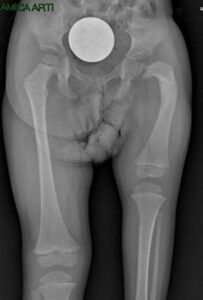
In intermediate cases, it presents a pseudarthrosis : the segment of the head and that of the diaphysis are not continuous with each other, in between there is a pathological, non-ossified tissue, which does not provide stability to the segment.

In severe cases of Proximal Femoral Focal Deficiency, there is severe abnormality with the absence of the entire proximal femur and part of the diaphysis.
In these cases, an MRI scan is useful. In some cases, for example, a pseudarthrosis is misdiagnosed in cases of simple delayed ossification, which improves spontaneously over time.

Knee problems
In Congenital Femoral Deficiency (CFD), the knee can present different conditions. The most common is genu valgum, which is usually secondary to hypoplasia of the lateral femoral condyle. Hypoplasia or absence of the cruciate ligaments (anterior and/or posterior) is also often present: unfortunately, this often goes unrecognized if the evaluator has little experience with these pathological conditions, but it must be carefully considered in the treatment plan. A flexion deformity of the knee is also quite common .
Classifications of Congenital Femoral Deficiency (CFD)
Several classifications have been devised to describe the different pathological pictures of Congenital Femoral Deficiency (CFD) and to guide the surgeon in therapeutic management and prognosis.
The aforementioned Aikten classification describes the alterations of the proximal femur: from type A in which the pseudarthrosis resolves and ossifies with growth, to type D, the most serious, in which there is no femoral head and the femoral diaphysis is very short or absent.
Among the various classifications of femoral hypoplasia , also due to our connection with the School of Pediatric Orthopedics of the Rizzoli Orthopedic Institute, we would like to recall the classification of Dal Monte and Donzelli (O. Donzelli, L. Valdiserri: classification and long-term prediction of lower limb dysmetries: “Current news in orthopedic surgery” 1982: 573-579):
- Type 1: Miniature femur : with valgus knee due to hypoplasia of the external femoral condyle, percentage deficit 19%
- Type 2: excurvated diaphyseal femur : moderate acetabular dysplasia, maximum percentage deficit 15%
- Type 3: hypoplastic femur with coxa vara >90 degrees : severe acetabular dysplasia, maximum percentage deficit 33%
- Type 4: hypoplastic femur with coxa vara <90 degrees : severe coxa vara with maximum percentage deficit 68%;
- Type 5: femur with subtotal hypoplasia : articulates with the pelvis by means of a neocotyl, maximum percentage deficit 84%

A useful classification for therapeutic decisions is the one described by Gillespie who divides patients into:
- Group A. Also called congenital short femur . The femur is up to 50% shorter than the unaffected side; the hip and knee are reconstructible. With the limbs extended, the foot on the affected side reaches at least halfway up the leg on the unaffected side.
- Group B and C. More severe cases, shortening of the femur greater than 50% or subtotal absence of the femur, the foot does not even reach halfway up the healthy leg (often to the knee level)
This classification aims to guide treatment decisions. The first group favors reconstruction and lengthening, while the second group favors prosthetics.
More recently, a further classification of femoral hypoplasia has been described by Professor Dror Paley which takes into account above all the factors related to the possible reconstruction of the limb:
- Type 1: intact femur , mobile hip and knee.
- Type 2: with pseudoarthrosis of the proximal femur
- Type 3: with failure of the diaphysis and proximal femur to form
- Type 4: with failure of the distal femur to form