


Complex limb deformities and shortening are problems that often occur together and require treatment by specialized centers. Our Center (Bologna, Italy) has international experience in this field.

Complex deformities and shortened limbs: what are the causes?
All pathologies that affect the growth of one or both limbs due to a local or generalized problem can cause a complex deformity of a limb, generally accompanied by shortening (=hypometria) of that limb. The causes can be:
- congenital (congenital short femur, Congenital Femoral Deficiency, fibular hemimelia, tibial hemimelia, congenital pseudarthrosis of the tibia, etc.)
- infectious (sepsis or septic arthritis that severely affects the joints and growth areas)
- traumatic (physeal or Salter-Harris fractures that damage the growth zones or fractures healed in a wrong position)
- developmental with various possible associated syndromes
- skeletal dysplasias that cause abonrmal bone development (multiple exostoses, etc.)
- other causes

What kind of shortening?
Patients often arrive at our Center with complex limb deformities in various spatial planes (frontal, lateral, rotation).
It is often associated with a shortening of more than 3 cm, up to severe cases with a difference in length of more than 15 cm.
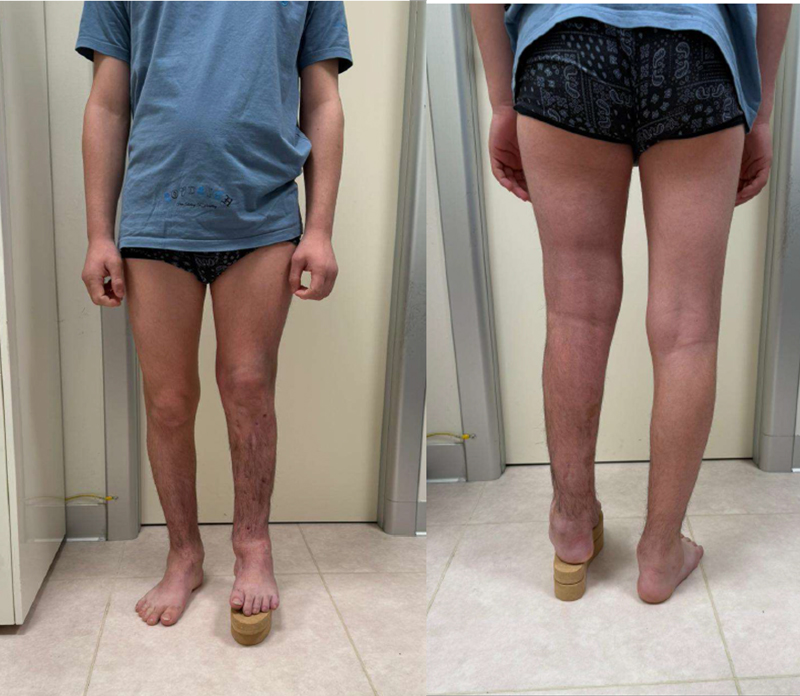
These are patients who have sometimes undergone various surgeries without resolution of the situation and who, in addition to the persistent bone deformity , are forced to wear significant internal and external lifts to the shoe.
All this is associated with gait alterations, pain, functional impotence, postural changes, associated scoliosis .
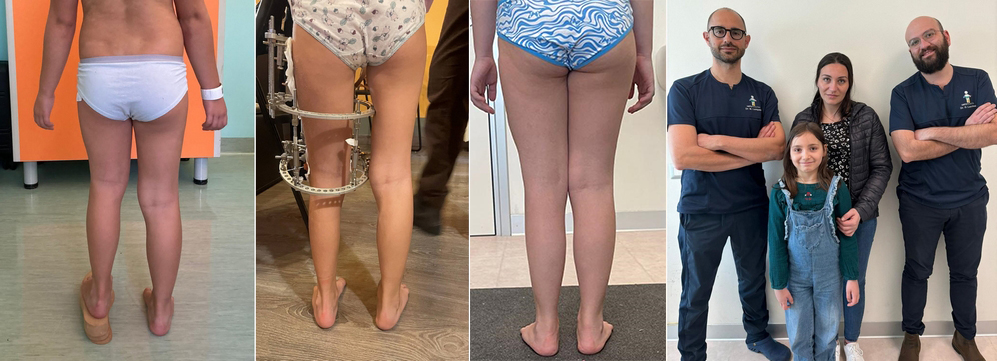
“REMOVE THE LIFT”!
We often repeat it to our patients as an “encouragement” to face the treatment process. Unfortunately, these patients are forced to wear significant and unsightly lifts and often use custom-made shoes.
Seeing them gradually succeed in removing the lift and wearing normal commercial footwear is a source of great satisfaction for the patient first of all and then for the families and doctors.
Obviously the other goal is to restore the normal mechanical axis and improve the functionality of the limb.
The basis of everything: adequate planning
It is essential to understand the pathophysiological cause of the problem and develop a targeted treatment plan.
- Errors in radiographic studies: We see many cases of patients who undergo inadequate radiographic studies; often, x-rays are taken without lifts, and as a result, abnormal postures are assumed that provide incorrect information.
- Correctly performed radiographic examination: At our center, we perform x-rays with direct control of patient positioning by the orthopedic doctors who plan treatment. This provides an optimal view of the actual situation.
- Prediction of length discrepancy at the end of growth: in growing subjects, it is essential not only to quantify the length difference present at that moment, but also to make a prediction of how much this difference could be at the end of growth, because it is this value that will have to be considered in the treatment plan.
Can both deformity correction and limb length restoration be performed?
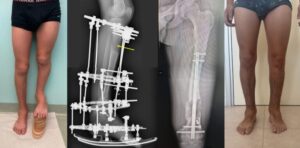
As mentioned previously, in many cases we treat both the bone deformity and the limb length discrepancy . Therefore, we correct both issues in a single procedure.
Is it possible to treat a rotational defect as well?
Often, there is also inward or outward torsion, resulting in a toe-in or toe-out gait. This can be treated along with deviations in other planes and lengthening.
Is it possible to treat joint stiffness too?
These conditions may include associated joint contractures, affecting the hip, knee, ankle, foot, or elbow. These problems may be associated with other conditions (hypometria, deformity) or may be isolated (flexion contracture of the knee in pterygium syndrome or arthrogryposis, for example) and require appropriate treatment.
Correction of the deformity and bone lengthening: what are the phases involved?
- Phase 1: Preparatory assessment. Study of the patient’s type, radiographic images, choice of lengthening type, goals.
- Phase 2: Surgery . The bone is sectioned (=osteotomy) and the lengthening device is applied. If necessary, acute correction of the deformity is performed.
- Phase 3: Lengthening and correction of the deformity. The progressive lengthening and correction of the deformity begins. This phase is followed both inpatiently and on an outpatient basis with serial check-ups. Physiotherapy is also performed during this phase to maintain muscle tone and length.
- Phase 4: Bone consolidation phase This is the time during which the “new bone” must consolidate. At this point, the external or internal device is removed.
Lengthening and deformity correction: is it a safe procedure?
The answer is YES if the procedure is performed by expert teams who constantly monitor patients throughout all phases and are able to minimize the risk of complications and know how to appropriately manage them when they occur.
Where to have the surgery performed?
It’s crucial for this type of procedure to work with surgical teams familiar with it. Our team performs these procedures regularly.
In addition to the actual surgery itself, it is essential that the patient is monitored step by step to limit the risk of complications.