


Blount’s disease: what is it?
Blount’s disease is a growth disorder affecting the inner portion of the growth plate at the top of the tibia (proximal tibia), which causes the progressive onset of bow legs / genu varum (see the fact sheet)
Due to this disorder, the inner portion of the growth plate slows down, while the outer portion continues to grow. This leads to a gradual varus deformity of the knee with severe deformation of the knee joint structures.
Two forms are distinguished, based on the age of onset:
- the most frequent is the infantile one with onset before 8-9 years of age (usually around 2-3 years of age)
- an adolescent form that makes its onset after the age of 9-10.
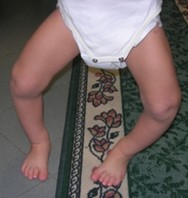
Blount’s disease: evolution
The typical history of the infantile form of Blount type genu varum is a progressive varus deformity that progresses rapidly during the second, third, or fourth year of life.
The lower limb axis of affected patients (one or both) presents with genu varum, with a marked deviation of the leg immediately below the knee, associated with tibial torsion , causing the toes to deviate inward. When walking, the knee itself buckles outward (and the genu varum becomes even more pronounced).
Blount’s disease: diagnosis
It is the pediatric orthopedic surgeon’s role to suspect Blount’s disease, distinguishing it from both physiological forms of genu varum and other forms of secondary genu varum. To this end, radiographic examinations may be performed to identify the pathology’s typical features.
Once a definitive diagnosis of Blount’s disease has been made, treatment must be initiated promptly.
Blount’s disease: treatment
Surgical treatment of Blount’s disease is a complex and requires centers with specific experience in this condition, such as OrthoChildren Center.
Go to the page dedicated to the treatment of Blount’s disease