


Fibular hemimelia in children: how is it treated?
Treatment of fibular hemimelia in children must not only consider the shortening of the bones but must also consider all the aspects already mentioned in the related factsheet.
Achieving equalization of the length difference without maintaining adequate joint function (especially the knee and ankle) and correct foot support leads to poor functional outcomes. This is one of the main errors made in the past in the treatment of fibular hypoplasia .
Therefore, corrective procedures mainly include:
- Leg-ankle-foot realignment procedures
- Lengthening procedures for equalizing the length difference
Ankle and foot realignment procedures for fibular hypoplasia: SUPER-Ankle procedure (see related factsheet)
In fibular hemimelia, it is preferable to correct the foot and ankle deformity early (18-24 months of age)
and maintain it as the child grows, rather than having them walk with their foot in the deformed position. Various procedures have been described for this purpose, depending on the type of deformity present. The various alterations present (residual fibular joint, ankle valgus, subtalar fusion, peroneal and Achilles tendon contracture, etc.) are corrected to ensure good foot support.
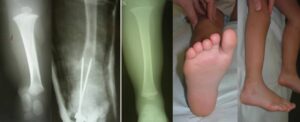
The combination of all these procedures, in the most severe cases of fibular hemimelia , is called the SUPER-Ankle procedure (Paley D, J Child Orthop 2016: Surgical reconstruction for fibular hemimelia)
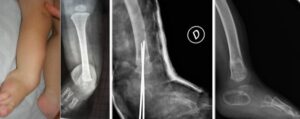
Leg lengthening procedures for leg hypoplasia
It is first necessary to calculate the expected length difference at the end of growth. Based on this, a treatment plan will be established (see fibular hypoplasia fact sheet).
It is absolutely incorrect to base treatment solely on the length difference present at the time of evaluation in a patient who is still growing.
Based on the expected length discrepancy, the number of procedures necessary to equalize the length difference at the end of growth will be determined.
When establishing a treatment plan for leg hypoplasia , it should be considered that in general:
- Each lengthening intervention can achieve a lengthening of the segment of up to 7/8 cm (maximum 5 cm in children under 4 years old)
- procedures must be separated from each other by at least 4 years
- The possible presence of shortening of the femur must also be considered in the therapeutic program (see related sheet).

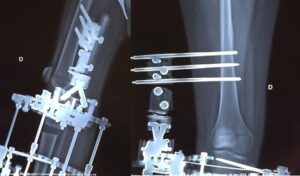
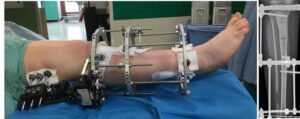
OrthoChildren Center performs all these procedures