


Intramedullary magnetic nail limb lengthening is a modern orthopedic surgical technique that allows limbs to be lengthened from the inside, without the bulk of traditional external fixators, with considerable advantage for the patient.
Limb lengthening using magnetic intramedullary nails: how does it work?
This procedure has the following characteristics:
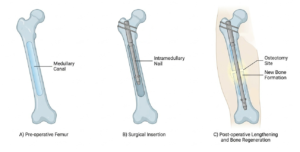
- Osteotomy and gradual lengthening: As in external fixator lengthening, a controlled cut (osteotomy) is made of the bone to be lengthened and this cut is separated (distraction) at a rate of 1 mm per day (variable depending on the case), thus allowing the body to produce new bone to fill that gap.
- Telescopic nail: the difference compared to external fixators is that to guide the distraction of the two separate bone parts, we do not use the external cage of the fixator but a metal device surgically inserted inside the medullary canal of the bone.
- Magnetic Control: An external remote control (called ERC or External Remote Controller) communicates with a small internal magnet at the nail. By operating the device, the nail lengthens the bone millimeter by millimeter
Limb lengthening using magnetic intramedullary nails: advantages
This is a complex procedure, requiring specific knowledge and experience in this area, but offering significant advantages.
- No external components: The absence of K wires or fiches that pass through the skin drastically reduces the risk of infections, which occur very often in the case of external fixators.
- Comfort: Improves tolerability and mobility in daily life
- Pain and functional recovery: Since there is no traction on the soft tissues (both skin and muscle), the pain is less significant and the physiotherapy process is facilitated compared to the use of external fixators
Magnetic intramedullary nails: indications
The main indications for this procedure are:
- Limb Length Discrepancy, LLD, that is, the difference in length between one limb and another (see sheet)
- Lengthening for pathological short stature (dwarfism, achondroplasia, etc)
- Lengthening for aesthetic purposes (see sheet)
Limb lengthening with an intramedullary magnetic nail is now supplanting the use of external fixators for all cases where both can be used.
In other words, in cases where it is possible to use a fixator or an internal nail indifferently, the use of the nail is generally recommended for the whole series of advantages set out above.
Magnetic intramedullary nails: limits
The main limitation of this procedure is anatomical: to insert the nail into the medullary canal, a fairly wide and straight canal is required. Therefore, it is not possible to apply the procedure in the presence of serious deformities or previous infections.
Alternatives to evaluate:
- In some of these situations or in the case of pediatric patients, for example under 10 years of age, a possible alternative is EMILL (ExtraMedullary Implantable Limb Lengthening), in which the nail for lengthening the limbs is attached to the outside of the bone, under the skin and muscle, rather than inside the bone itself (see sheet).
- If it is necessary to lengthen the limbs in the presence of complex deformities, the use of external fixators (traditional or hexapodal) is generally necessary (see sheet).
The OrthoChildren team (M.Lampasi and G.Lucchesi) has experience in all these types of interventions and can apply the best device for each individual case. In some cases the procedures may be associated at different levels.

Magnetic intramedullary nails: how much lengthening is possible?
It usually allows you to gain between 4-5 cm and a maximum of about 6-8 centimetres per bone segment.
Intramedullary nail for lengthening: which nail?
There are several nails available for this procedure (Precice, Fitbone Orthofix, etc). The team will evaluate which nail to use in each individual case.
A new nail, the Precice MAX nail, has recently been introduced to the market and offers several additional advantages:
- reinforced nail walls and increased mechanical strength
- ability to support the load from the first few weeks
- reduction of time spent in a wheelchair with the possibility of walking much earlier
- less loss of muscle mass
- stimulation of bone regeneration thanks to the load
- faster functional recovery
Intramedullary magnetic nail: is it a simple procedure?
It is a procedure that requires surgical experience and involves a constant follow-up path, with rigorous rehabilitation commitment and constant medical checks during the bone consolidation phase.
It’s not just about inserting a nail into a bone segment, but about following the patient along the way and monitoring their functional recovery.
Traditional principles concerning limb lengthening (respect for muscles, maintenance of joint function, etc.) must be constantly taken into account.
Intramedullary magnetic nail: the follow up visits
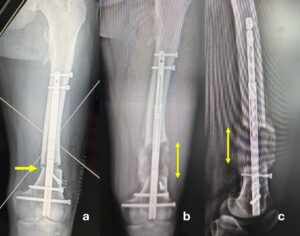
During the lengthening phase, clinical and radiographic checks are performed, generally every 2 weeks, to verify the quality of the newly formed bone, limb alignment, correct functioning of the device, and the patient’s joint function.
Intramedullary magnetic nail: is it a safe procedure?
The answer is YES if the procedure is performed by experienced teams who constantly monitor patients at all stages and are able to minimize the risk of complications and manage them adequately when they occur.
However, we are talking about a complex orthopedic procedure and we must consider the risk of minor complications (pain, stiffness, superficial infections, etc.) or major complications (deep infections, fractures, delayed consolidation, early consolidation, angular deviations, etc.) that may require further procedures. It is precisely under these conditions that it is important to be supported by teams capable of managing difficulties.
Intramedullary magnetic nail: where?
It is essential to consult surgical teams who are familiar with this procedure. Dr. Manuele Lampasi and Dr. Giovanni Lucchesi of the OrthoChildren Center regularly perform these procedures..