


Extramedullary Implantable Limb Lengthening is a modern orthopedic surgical technique designed to facilitate limb lengthening in young children or patients with small, narrow or deformed bones.
Internal extramedullary lengthening, known by the acronym EMILL (ExtraMedullary Implantable Limb Lengthening), is a surgical technique in which a motorized/magnetic nail for limb lengthening is attached to the outside of the bone, under the skin and muscle, rather than inside the bone.
This is a complex procedure, requiring specific knowledge and experience in this area, but offering significant advantages.
Extramedullary Implantable Nail for Limb Lengthening: why?
This technique responds to a specific need: limb lengthening procedures are progressively moving from classic external fixator lengthening to the use of internal intramedullary magnetic nails (see dedicated sheet). The use of internal magnetic nails in fact brings enormous advantages, in terms of patient tolerability, complications, and functional recovery times.
In younger children, for example under 10 years of age, or in patients with small or deformed bones, intramedullary nails cannot be used, due to the presence of growth plates or the short length and diameter of the bones.
External fixators are therefore generally used for these situations, which offer several advantages (particularly in the possibility of correcting complex deformities during lenghtening), but have the disadvantage of bulk, complications, poor tolerability and prolonged recovery times.
Internal extramedullary lengthening, on the other hand, allows magnetic nail lengthening procedures to be applied to these situations (lower age group, smaller bones, etc.), reducing patient discomfort, scarring, recovery times, and complications.
Dr Manuele Lampasi and dr Giovanni Lucchesi from OrthoChildren Center (Bologna, Italy) use this technique, in cases where it is indicated. In fact, such a procedure cannot be applied in all cases and an appropriate preliminary assessment is important.
Extramedullary Implantable Limb Lengthening: how does it work?
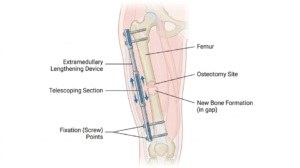
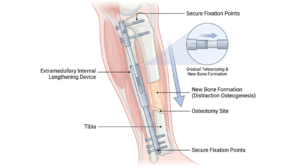
The procedure includes the insertion of a magnetic nail, capable of lengthening the bone. However, the nail remains extramedullary, that is, outside the medullary canal of the bone, and functions as an external fixator BUT it is located inside the tissues and is not visible.
- Nail placement: the magnetic nail is fixed directly to the outer surface of the bone by means of screws at both ends of the bone segment.
- Guidance rod: A small-gauge metal nail is often inserted into the medullary canal of the bone to maintain alignment and protect it from bending forces during lengthening.
- Corticotomy (=bone section): The bone is sectioned between the two ends, usually with minimal access, so that the two ends can then be separated by the magnetic nail.
- Lengthening: The bone is lengthened at a rate of 0.75/1 mm per day
- Lengthening limits: It is generally recommended not to lengthen the bone beyond 5 cm to reduce the risk of complications.
Extramedullary implantable limb lengthening: is it safe?
The answer is YES if the procedure is performed by experienced teams who constantly monitor patients at all stages and are able to minimize the risk of complications and manage them adequately when they occur.
Limb lengthening with an internal extramedullary nail: who to contact?
It is essential to contact surgical teams who are familiar with this procedure. The OrthoChildren Center team performs these procedures regularly.
In addition to the intervention part in the strict sense, it is essential that the patient is followed step by step to limit the risk of complications.
Is it possible to carry out this procedure in Italy?
Until a few years ago, many families traveled abroad to perform this procedure, facing exhausting journeys, long hospital stays, physiotherapy, and sometimes exorbitant expenses.
Fortunately, for several years now, these procedures have been possible in Italy, significantly reducing expenses and family commitments. In recent years, the process has even reversed, and several patients come from abroad to perform this procedure at our center.