


The SUPER-Knee procedure is a complex procedure to correct some malformations present in the knees of limbs affected by congenital hypoplasia (fibular hemimelia, congenital femoral deficiency CFD, etc). This is a complex procedure for a rather rare condition, requiring specific knowledge and experience in this field.
SUPERKnee Surgery: our experience
OrthoChildren (Bologna, Italy) is among the international centers with experience in this field.
Dr. Lampasi has been specializing in congenital hypoplasia and joint reconstruction for years. He worked first at the Rizzoli Orthopedic Institute (Bologna, Italy), where many of the first scientific studies on this type of procedure and congenital hypoplasia were conducted (Prof. Dal Monte, Dr. Donzelli). He then served as Head of Pediatric Orthopedics at Meyer Hospital in Florence, where he performed several complex procedures in this field for the first time at that hospital. Finally, he performed numerous cases of joint reconstruction (SUPER procedures, etc.) at various public and private Italian hospitals, also providing consulting and training to other pediatric orthopedic surgeons.
Dr. Lucchesi has been dedicated to the treatment of congenital hypoplasia for years, has attended numerous courses and conferences held by Professor Dror Paley, who systematized many of the procedures in this field, and has undertaken extended training periods with Dr. Alexander Kirienko, a luminary in external fixation with the Ilizarov apparatus.
SUPERKnee Surgery: What does SUPER mean?
The SUPER-Knee procedure belongs to a series of procedures with the prefix SUPER, an acronym that stands for Systematic Utilitarian Procedure for Extremity Reconstruction, conceived and systematized by Professor Dror Paley.
In congenital hypoplasias (fibular hemimelia, tibial hemimelia, femoral hypoplasia, Congenital Femoral Deficiency CFD), the affected limbs are not only more or less significantly shorter, but also show associated deformities at the level of the main joints: hip, knee, ankle, foot.
In the past, these deformities were given less importance and the goal was exclusively to lengthen the limbs. However, this often resulted in limbs of adequate length but stiff or poorly functional.
Over the years, it has been understood that before lengthening a limb, it is essential to restore good joint morphology to optimize functionality and limit lengthening complications.
This is why the SUPER- procedures were developed.
SUPERKnee surgery: what does it involve?
The SUPER-Knee intervention aims to:
- Reconstruct the knee ligaments (anterior cruciate, posterior cruciate, etc.), in case of their congenital absence (agenesis)
- Correct any knee flexion contracture
- Realign the kneecap (patella) if it is not centered properly.
SUPER-Knee Surgery: Why Do It?
In congenital hypoplasias (fibular hemimelia, tibial hemimelia, femoral hypoplasia, Congenital Femoral Deficiency CFD), the ligamentous apparatus that serves to stabilize the knee is often not well developed, both in the antero-posterior and rotational direction.
This has two main consequences:
- Some children have symptoms of knee instability, which increase as they grow and become more functionally demanding (sports activities, etc.).
- An unstable knee is more at risk of developing complications following limb lengthening surgery.
The SUPER-Knee procedure aims to restore ligament stability , using the patient’s own fascial structures.
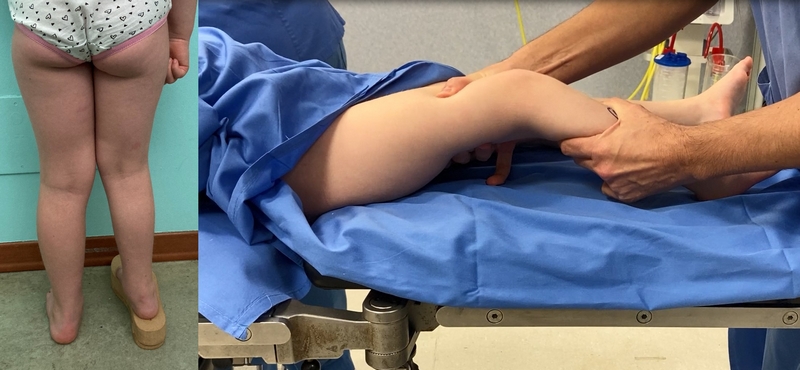
SUPER-Knee Surgery: Is It Always the Same Procedure?
Knee deformities in congenital hypoplasias are highly variable.
Knees range from completely stable to severely unstable. The kneecap (patella) may be centered, subluxated, or dislocated. In some cases, a flexion contracture is present. In many cases, a valgus deviation is present.
The procedures to be performed will have to be adapted to the current situation: from simpler procedures to more complex interventions.
Experience is required to properly dose this procedure.

SUPER-Knee surgery: at what age should it be performed?
We typically perform the surgery around age 3-5, before starting the limb lengthening program.
SUPER-Knee Surgery: When to Plan for Limb Lengthening?
Once the knee (and hip and ankle, if needed) joint reconstruction program has been completed, it is possible to schedule limb lengthening procedures: see the dedicated sheet.
If the lengthening program is approached without taking into account the changes in the knee, there is an increased risk of complications (dislocations, stiffness, joint contractures) or of having a poor outcome at the end of the lengthening.
SUPER-Knee surgery: can it be performed in Italy?
Until a few years ago, many families traveled abroad to undergo this procedure, facing grueling journeys, lengthy hospital stays, physiotherapy, and sometimes exorbitant expenses.
Fortunately, for several years now, these procedures have been available in Italy, significantly reducing costs and family commitments. In recent years, this trend has even reversed, with many patients coming from abroad to undergo this procedure at our center.