


Information and utilities for hospitalization

Clinical documentation (to be prepared in advance)
Once the cost estimate has been accepted and the location/period of the intervention have been established (see sheet: admission procedures), it is advisable to prepare:
- Diagnostic examinations requested by the surgeon (X-rays, CT, MRI, etc)
- Preliminary general investigations: Evaluate with your family doctor if it is necessary to perform other examinations (which, if highlighted close to the hospitalization, would risk canceling the procedure). As a support, you can use the attached OrthoChildren Anesthesiological Questionnaire
- Recent medical reports (cardiological, neurological, pulmonary visits, hospitalization reports, etc.) if the patient is being treated for specific underlying problems or particular syndromic conditions
- Device documentation: if the patient is carrying a medical-surgical device (e.g. Baclofen pump, ventriculo-peritoneal diversion, etc.), a recent evaluation certifying its adequate functioning or describing specific needs will be required
Questionnaires
- when the time of hospitalization approaches, facilities typically require the completion of a medical questionnaire such as the OrthoChildren Questionnaire or the Sol et Salus Questionnaire.
- In case of changes (appearance of cough, cold, fever, etc.) in the days following the sending of the questionnaire and preceding hospitalization, a reassessment by the family doctor and timely communication to the hospitalization office will be appropriate.
Personal therapies
- If the patient is taking antiepileptic therapy, it will be advisable to schedule a dosage of the therapy close to admission (with possible evaluation by the neurologist following the therapy). The importance of carrying these drugs with you and continuing therapy even during the days of surgery and hospitalization is emphasized
- If the patient is taking specific personal therapies (for example, for diabetes), it will be advisable to request a perioperative therapy management scheme from the center that follows him. The importance of carrying these drugs with you is emphasized so that you can continue therapy even on the days of hospitalization.
Pre-op labs
- Blood tests and ECG will be performed at the time of pre-admission
- If you have already experienced significant difficulties in performing blood sampling and have a trusted referral center where you usually perform the sampling, or if there are conditions that need to be reevaluated before hospitalization, we recommend performing the sampling before pre-hospitalization. In this case, it will be advisable to arrange the sampling and tests to be performed with the hospital admissions office (validity 3 months).
Delegation from the other parent
- The minor must be accompanied at all stages by (at least) one of the two parents. It is necessary to bring to pre-hospitalization the signed delegation of the other parent to perform health services on a minor, accompanied by a photocopy of the identity document of the delegator: see Fac-simile delegation.
Other utilities for hospitalization
Post-operative braces
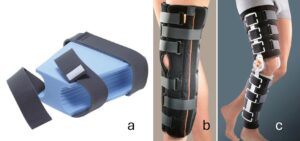
- Some procedures require a post-operative brace. Some examples:
- Hip dislocation reconstruction surgery in Cerebral Palsy: Hip pillow (a)
- SPML, fibrotomy, Achilles lengthening in CP, femoral osteotomy, discoid meniscus surgery: long rigid orthopedic knee brace (b)
- In some specific case: hinged orthopaedic knee brace (c)
-
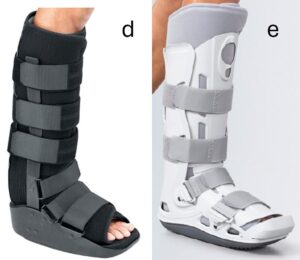
- Calcaneo-stop / arthroereisis for flatfoot: rigid long Walker brace (d, e): not short ankle brace, nor hinged brace
- Who procures the braces?
- It is possible to procure braces yourself
- or contact an orthopaedic workshop in the vicinity of the surgical facility. For example:
- In Bologna: Officina Biotecnica (+39) (0)51-313747
- In Bologna: Laboratorio Ortopedico Monzali (+39) (0)51-522626
- In Bologna: Sanitaria Bononia (+39) 349 2465753
- A Rimini (Torre Pedrera): Ortopedia Rizzoli (+39) (0)541-391892
- Or report the request in advance to the secretariat info@orthochildren.org to have the braces arrive on the morning of admission
Crutches
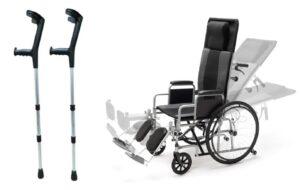
- For all procedures that involve immobilization (cast, brace, etc.) or a limitation of walking and weightbearing, the use of two anti-brachial sticks is foreseen in the first post-operative period
- You can get them yourself or request them from the workshops together with the braces
Post-operative wheelchair
- In some procedures where immobilization is required without the possibility of placing one or two limbs on the ground for a certain period, the Doctor will recommend renting a wheelchair with elevating footrests; possibly also with a reclining backrest for hip surgery
- However, it is not necessary to take this wheelchair to the hospital
- if your stay in Italy is extended beyond your hospital stay, it is advisable to rent a wheelchair in one of the workshops listed above
Home return
- By car (a comfortable machine is recommended): the patient can be positioned in the front/passenger seat with the backrest down or behind; the operated limb should be held up in the back seat or on cushions (it is useful to prepare cushions for this purpose)
- By plane: enquire with the airline about flight arrangements, availability of assistance at the airport, need for specific certificates; it is prohibited to travel by plane in the 48 hours following the packaging of a closed cast
- By train: check for assistance at the station (wheelchair transport); pillows are useful if the patient is wearing a cast