


Patients with spina bifida may experience several hip problems:
- Hip contractures. Soft tissue release procedures are indicated for hip contractures in abduction-external rotation or flexion that interfere with function (standing, walking, use of braces), only after appropriate clinical evaluation.
- Subluxation and dislocation. This is a very common problem in children with myelomeningocele: it is generally an imbalance between functional flexor/adductor muscles and impaired extensor/abductor muscles that causes a progressive alteration of the relationship between the femur and the acetabulum, leading to complete dislocation.
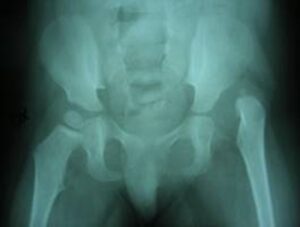
Hip dislocation in spina bifida: treatment
Treatment requires a thorough functional assessment (evaluation of muscle function, neurological status, pelvic obliquity, spinal alignment, walking ability, etc.) and not a simple radiographic evaluation. The
fundamental question is whether or not to proceed with complex dislocation reduction and joint reconstruction procedures.
Indeed, it is necessary to consider, on the one hand, the potential advantages of a reduction (in particular, stabilizing the joint, avoiding length differences between the two limbs, preventing pelvic obliquity and scoliosis), but on the other, the high complication rate that can be associated with treatment (risk of stiffness, fractures, ossifications at the surgery site, high risk of recurrence of the dislocation after treatment).
The main objective , however, remains to maintain joint flexibility and resolve contractures that can cause obliquity of the pelvis itself.
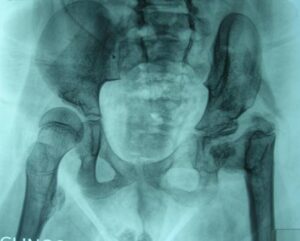
Hip dislocation in spina bifida: surgical procedures
If, following the functional assessment, the objective is to reduce the dislocation, the patient is subjected to a surgical program that includes (in a single surgical stage or in several surgical stages):
- open reduction of the hip
- femoral osteotomy
- pelvic osteotomy
- Muscle-tendon release procedures (iliopsoas, adductors) and tendon transfers to balance muscle imbalances (iliopsoas transfer according to Sharrard or according to Mustard, transfer of the external oblique muscle from the abdominal wall muscles to the greater trochanter)
OrthoChildren Center performs all these procedures