


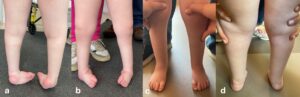
Spina bifida: Orthopedic surgery for the lower limbs
Children with spina bifida (myelomeningocele) present a broad spectrum of musculoskeletal problems.
There is a wide variability in neurological involvement in these patients (thoracic, upper lumbar, lower lumbar, and sacral levels, associated Arnold-Chiari malformations, associated hydrocephalus, spinal cord tethering during growth , etc.) and in lower limb deformities present at birth.
The goals of orthopedic treatment will therefore be very different, especially depending on the severity of the involvement:
- from improving foot support and walking in children with mild neurological involvement
- to improving sitting position and spinal alignment in more serious patients.
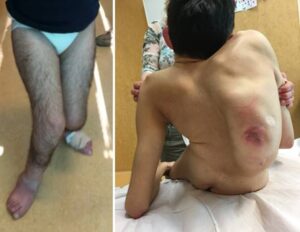
The treatment of children with spina bifida (myelomeningocele) is very complex and requires multidisciplinary work (neurosurgeon, urologist, general surgeon, physiatrist, physiotherapist, orthopedic surgeon, orthopedic technician, psychologist, occupational therapist, etc.).
An in-depth analysis of the pathogenetic, clinical and therapeutic aspects of this condition is beyond the scope of this paper.
Here we will summarize the main problems affecting the lower limbs that may require surgical treatment and list the surgical procedures most frequently performed for these problems.
Foot and ankle deformities in children with spina bifida
- Calcaneus deformity: This deformity, quite common in children with spina bifida, may be present at birth, but generally develops later, due to a muscular imbalance (active tibialis anterior, deficient plantar flexors). An anterior release procedure may be necessary, combined with transfer of the tibialis anterior (and possibly other tendons) to the calcaneus, or, in patients at the end of growth, an arthrodesis of the ankle joint.
- Talipes equinovarus (or congenital clubfoot): Feet with this congenital deformity are generally stiffer, more resistant to treatment, and at greater risk of recurrence than idiopathic clubfoot (see fact sheet on clubfoot ). Treatment with casts using the Ponseti method can be attempted, but the increased risk of pressure sores in the cast (related to impaired sensation) must be taken into account.
Alternatively, posterior and medial soft tissue release surgery is necessary.
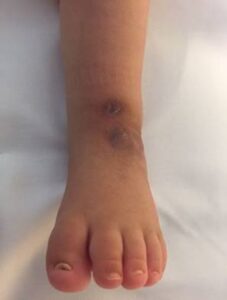
- Equinus deformity: in cases of pure equinus deformity that does not respond to conservative treatment (braces, physiotherapy), corrective interventions are indicated (lengthening of the Achilles tendon, posterior release)
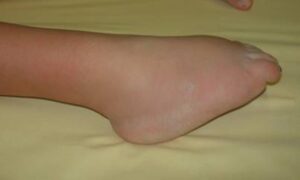
- vertical talus: this is a complex deformity of the foot that is already present at birth and in most cases requires corrective intervention on the soft tissue (posterior, medial, plantar and lateral release)
- Foot and ankle valgus. These are fairly common problems in children with spina bifida, which can cause problems with the use of insoles and braces. The orthopedic surgeon must distinguish the location of the deformity (ankle valgus, foot valgus, or both).
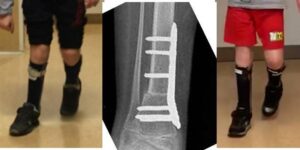
In the case of ankle deformity , surgical options include corrective osteotomy of the distal tibia and asymmetric hemiepiphysiodesis of the distal tibia (i.e., progressive correction of the deformity in growing patients).
In the case of localized deformity in the foot (subtalar joint), the orthopedic surgeon will have to evaluate the most appropriate surgical procedure among the various options (arthrodesis, osteotomies, etc. ) taking into account the specific characteristics of children with myelomeningocele.
Hip deformities and dislocations
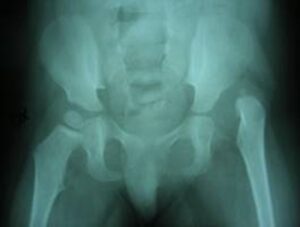
Go to the fact sheet dedicated to hip dislocation in spina bifida.
Knee deformities in spina bifida
- Flexion contractures. Hamstring lengthening procedures or distal femoral extension osteotomies may be necessary if progressive flexion deformities of the knees interfere with walking.
- Extension contractures. These deformities rarely require surgical treatment (quadriceps lengthening).
Torsional deformities of the lower limbs in spina bifida
Torsional (rotational) deformities of the lower limbs (particularly external tibial torsion ) are quite common in ambulant patients with spina bifida and can cause problems with the use of braces and gait. After careful clinical evaluation and possible CT reconstruction of the torsional axes, a derotational osteotomy may be indicated.
Patients from abroad: can OrthoChildren Center treat foreign patients?
Yes, many patients come from all countries (Europe and USA):
- the surgical equipe has a wide experience with Spina bifida
- an intensive rehabilitation program can be included
- the procedure is less expensive than in USA and other countries
- Families take advantage of this opportunity to combine a trip to the beauties of Italy
Casi Clinici Correlati