


Hemi-epiphysiodesis (guided growth) for valgus knee is a simple and highly effective procedure when performed properly. It involves the application of fixation devices (there are several options, the most common being the “eight-plate”) to the inside of the knee to slow growth in this area. Growth continues in the remaining cartilage, which, pivoting on the plate, gradually corrects the valgus deformity.

Plates can be placed on the femur (most commonly) and/or the tibia depending on the location of the deformity.
The axis correction does not take place directly in the operating room, but progressively over the months, at a speed proportional to the growth of the operated limb.
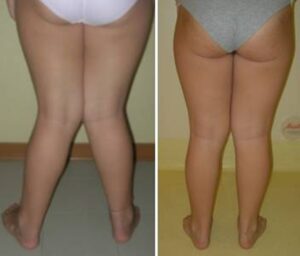
Hemi-epiphysiodesis (guided growth) for valgus knee: when is it performed?
The fundamental requirement is that the child have some residual growth . In other words, it is essential that patients are referred for evaluation of a possible epiphysiodesis during growth, and not afterward. Otherwise, this procedure will no longer be possible and an osteotomy will be necessary. Some auxological parameters (stage of pubertal development, growth velocity, bone age at the wrist and elbow) can help determine whether or not there is still room for surgery.
Hemi-epiphysiodesis (guided growth) for valgus knee: Is immobilization necessary?
It’s a minimally invasive procedure , requiring no immobilization or casting, and can be performed on both knees simultaneously. Patients quickly regain walking ability (using two canes for a couple of weeks is sufficient) and return to sports within a few weeks.
Hemi-epiphysiodesis (guided growth) for valgus knee: How is growth affected?
Furthermore, it is a temporary procedure : once the desired goal is achieved (i.e., once the axis is straightened), the plates can be removed to restart cartilage growth. Therefore, it is theoretically a reversible procedure.
Hemi-epiphysiodesis (guided growth) for valgus knee: what are the risks?
There are two possible and opposing risks to consider .
a) The risk of damage to the growth plate caused by the plate itself: once the plates are removed, the knee will continue to deviate in the direction of correction, leading to overcorrection.
b) The rebound effect : once the plates are removed, the area of cartilage that had been slowed down will resume excessive growth, leading to a recurrence of the condition.
For this reason, it is necessary to perform the procedures with the correct technique and it is often preferable (if it is possible to wait) to perform the procedures at the first signs of puberty, so as to achieve correction of the axis and avoid further growth that risks causing overcorrection or relapse.
In cases where the deformity is severe and the patient is still young, such as in cases of genu valgum secondary to skeletal dysplasia, it is preferable to perform the surgery during full growth, remove the plates once the limb’s axis has been corrected (or when the axis is slightly overcorrected), and check the behavior of the axis during growth; if necessary, the procedure can be repeated in the event of a recurrence of the condition.
Why is it important to turn to experienced centers?
The doctors at our center recommend epiphysiodesis in cases where the indication is clear. Unfortunately, in recent years, due to the relative simplicity of the procedure, there has been an unjustified expansion of its indications to include cases where the need for surgical correction has not been demonstrated.
