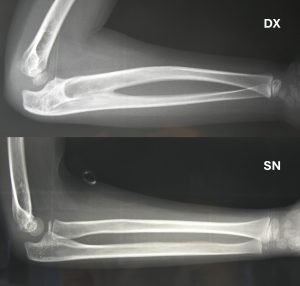
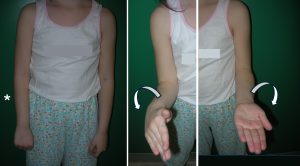
Congenital radioulnar synostosis is a rare malformation in which there is a fusion of the forearm bones (radius and ulna) which causes a limitation of pronation-supination movements.
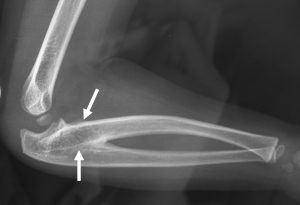
Although it is a congenital malformation, the diagnosis is often made around the age of 4-6, when the need to use the upper limb increases during school-age and the difficulty in using it or the need for compensation to carry out activities is noted.
Congenital radioulnar synostosis: treatment
Treatment of congenital radioulnar synostosis can be:
- conservative: observation only, in asymptomatic cases that do not cause significant functional limitation
- Surgical: if the synostosis causes excessive functional limitations or the inability to perform specific activities. This is particularly true if there is excessive forearm pronation and in bilateral cases.
Congenital radioulnar synostosis: which surgical procedure is recommended ?
Surgery for congenital radioulnar synostosis may include:
- attempts to free the synostosis and restore active motility in pronation and supination: unfortunately this type of intervention generally has limited results
- Forearm derotation . The forearm bones are sectioned (osteotomy) at the synostosis or further distally, rotated, and consolidated into a more functional position for use of the upper limb. However, these are complex procedures, with vascular and nervous risks, which must be performed in experienced centers such as OrthoChildren Center.