


This is a delicate procedure that must be performed by expert teams. It may be combined with femoral osteotomy.

Pelvic osteotomy for congenital hip dislocation: an experienced center in Bologna (Italy)
Our center has world-class experience in the surgical treatment of congenital hip dislocation.
Dr. Lampasi has been practicing congenital hip dislocation surgery for years, due to the extensive experience gained from his years at the Rizzoli Orthopedic Institute, integrated with international experience and innovative techniques.
He was Head of Pediatric Orthopedics at Meyer Hospital in Florence, where he performed (the first in that hospital) many surgical operations in this field.
He has been called as a consultant to various public and private Italian Hospitals to perform hip dislocation surgeries (open reduction, pelvic osteotomies, etc.), also carrying out training activities for other pediatric orthopedic surgeons.
He is a recognized member of the International Hip Dysplasia Institute.

For years, he has been carrying out educational and outreach activities online and collaborating with family support groups.
Pelvic osteotomy: what does it mean?
In the normal hip joint, the femoral head moves relative to the pelvis by rotating in a socket called the acetabulum. The part of the acetabulum where the femoral head rests is called the “roof”.
In hip dysplasia the roof may be too oblique, too vertical, underdeveloped or poorly oriented.
In this situation, the joint functions poorly and wears out prematurely; in the most serious cases, the head of the femur can even gradually slip out of the acetabulum and dislocate.
To correct this problem and restore the correct slope of the roof, a surgical procedure is necessary.
Acetabulopasty for congenital hip dislocation: what does it involve?
The aim of the pelvic osteotomy called acetabuloplasty is to narrow the acetabulum and to improve the inclination of the roof.
To do this, an osteotomy (=section of the bone) is performed immediately above the acetabulum, and a wedge of bone is inserted at this level like a shim, so as to lower the roof.
The wedge can be taken from the patient himself or from the bone bank. As the weeks pass, this bone consolidates and integrates with the baby’s bone.
Pelvic osteotomy: Are there other techniques?
In reality, acetabuloplasty is not the only possible procedure to correct this problem.
In case of dislocation or congenital hip dysplasia, different alterations may be found, which require different treatments.
An experienced center must know how to use different techniques depending on the specific case.
For example, pelvic reorientation osteotomies ( such as Salter osteotomy) are used when it is necessary to change the orientation of the acetabulum. In these cases, the osteotomy is performed above the acetabulum, the pelvic bone is rotated in the correct direction, and fixed with metal wires (Kirschner wires) until healing occurs.
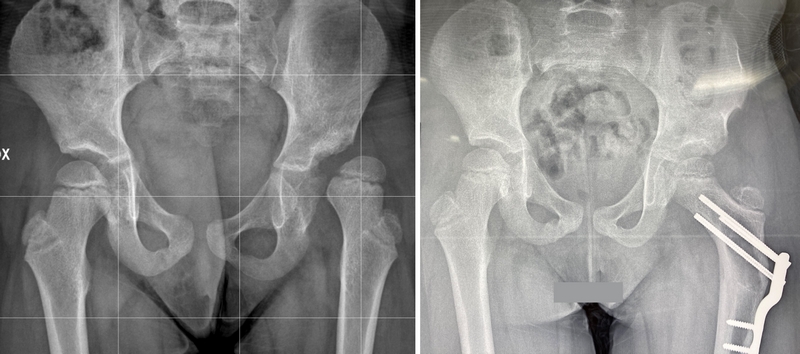
Pelvic osteotomy for congenital hip dislocation: when is it performed?
Patients with congenital hip dysplasia and dislocation must be followed over time with periodic radiographic examinations to verify the proper development of the acetabulum.
In case of incorrect evaluations, two types of errors can occur:
- being too hasty in operating on situations that could resolve spontaneously (or that do not require surgery)
- postponing too much the correction
Pelvic osteotomy for congenital hip dislocation: Can it be combined with other procedures?
Yes. In case of dislocation, it is possible to perform open reduction and pelvic osteotomy at the same time.
Furthermore, it is possible to associate femoral osteotomy in some cases.
Femoral osteotomy for congenital hip dislocation: what does it involve?
Bone development in patients with congenital hip dysplasia or dislocation must be monitored over time. If development is irregular, deformities of the roof and possibly also of the femur (femoral valgus, etc.) may be evident.
In these cases, corrective surgery on the femur can also be combined with pelvic osteotomy.
An osteotomy (=section of the bone) of the femur is performed, the bone is bent in the correct direction and fixed so that it can heal in the correct position.
Femoral osteotomy: how is it performed?
The femoral osteotomy can be fixed in different ways.
We once used percutaneous Kirschner wires or temporary hardaware, which were left protruding from the skin, beneath the cast. However, this system required prolonged immobilization in a cast and left unsightly scars; in some cases, they did not guarantee adequate stability and the correction was lost.
For this reason, this system has now been superseded by the use of more modern metal plates that guarantee greater stability and reduce the time these children spend in spica casts.
This is an aspect to consider in order to minimize the slowing down of motor development in these children.
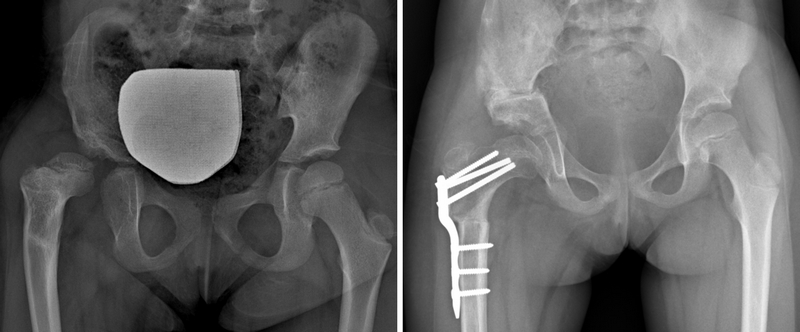
Pelvic and femoral osteotomy for congenital hip dislocation: where should the procedure be performed?
These are delicate procedures that require extensive experience. Ours is one of the few Italian centers with extensive experience in this type of procedure.