


Sometimes foot deformities can be so severe and rigid that there seems little chance of correction. In these cases, it’s essential to seek out centers experienced in advanced correction techniques.
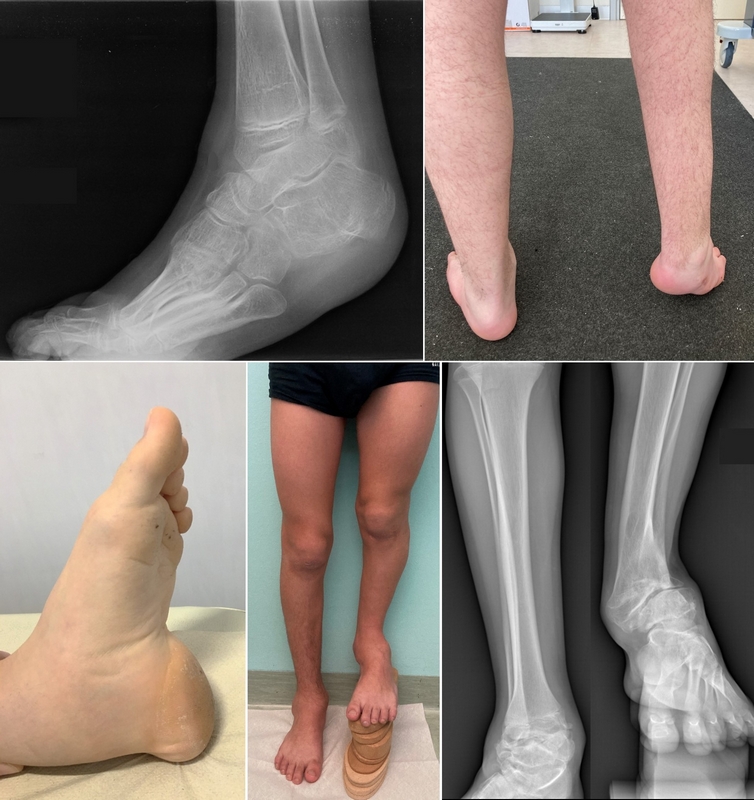
OrthoChildren (Bologna, Italy): a center with international experience
OrthoChildren and its doctors are among the most experienced international centers in this field.
Dr. Lampasi has been studying foot deformities and the conditions that can lead to these complex conditions for years. Over the years, first at the Rizzoli Orthopedic Institute (Bologna, Italy), then as Head of Pediatric Orthopedics at Meyer Hospital in Florence, and finally in the OrtoPediatria and OrthoChildren Center, he has treated numerous cases of complex deformities using various surgical techniques.
Dr. Lucchesi has been treating complex foot deformities for years and has acquired significant experience in this field, thanks also to extended training periods with Dr. Alexander Kirienko, a leading expert in external fixation with the Ilizarov apparatus, and thanks to attending courses held by Prof. Dror Paley.
The results of this experience have been published in international journals and shared at national and international conferences.
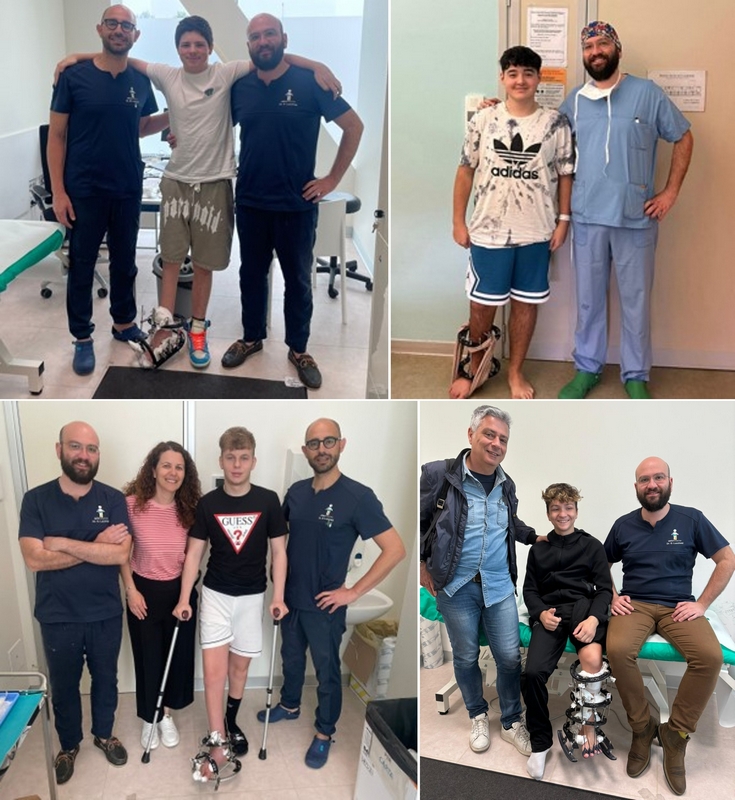
Treatment of complex foot deformities: what interventions are available?
There are several options for treating a foot deformity; interventions may include:
- Preliminary corrective casts to partially reduce the deformity, combined with minimally invasive percutaneous techniques (See sheet)
- Interventions on soft tissue (tendon lengthening, opening of capsules, etc.)
- Transfer interventions : i.e. transfer of tendons to balance the muscular forces so that they act in favor of the correction (See sheet)
- Epiphysiodesis procedures to guide growth plates in children’s deformities
- Bone interventions (= osteotomies ), when bone deformities have occurred
- Joint resection, correction and fixation procedures (= arthrodesis)
- External fixators
Treatment of complex foot deformities: which is the most suitable technique?
It is essential to understand the type of deformity and plan according to the patient’s age, the type of pathology that caused the problem, and the desired goal.
For example, if a deformity can be treated with casts and minimally invasive techniques (see sheet), it would be inappropriate to use soft tissue release procedures or osteotomies. Conversely, in cases of severe deformities, it is pointless to continue recommending percutaneous tenotomy.
Ours is one of the few centers that knows how to use all the above-mentioned techniques, adapting them to individual situations, and that knows how to use the Ilizarov method in the most complex and resistant cases.
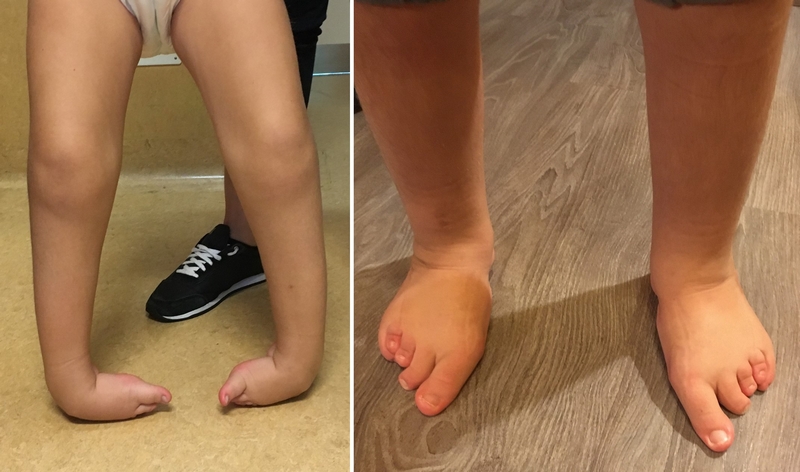
A solution for the most resistant paintings: the Ilizarov method
There are situations where the deformity is so severe that there seem to be few solutions:
- Rigid and complex deformities
- Feet that have already been operated on repeatedly and in which the deformity persists
- Deformed and short feet, associated with shortening of the limb (hypoplasias)
- Foot deformities in cases of arthrogryposis, severe congenital malformations, outcomes of trauma, etc.
- Resistant and repeatedly operated equine deformities
In these cases, there is actually a solution: the Ilizarov method. Ours is one of the very few centers internationally that uses this method to correct foot deformities.
Ilizarov foot: what does it consist of?
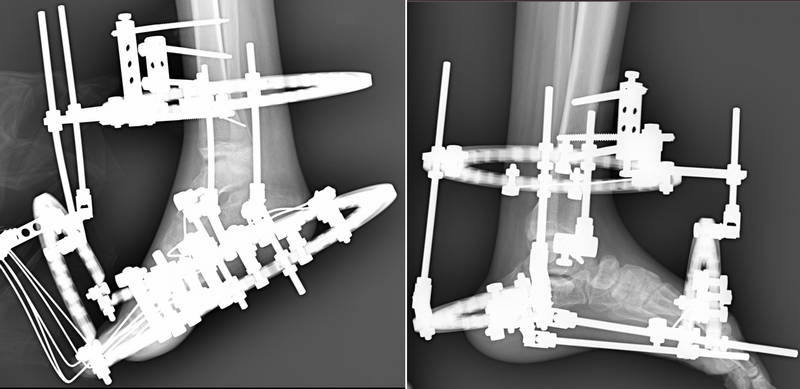
The Ilizarov method consists of a progressive and gradual correction of the foot deformity. The surgical procedure involves applying a circular external fixator, a sort of external cage, to the deformed foot to gradually guide it towards correction.
The external fixator consists of:
- Metal structures (Kirschner wires, fiches) that attach to individual bones of the foot so that they can be moved in the desired direction and with a power that other techniques do not possess. These structures are connected to:
- external rings that serve to govern the correction.
- The outer rings are connected to the other rings by means of gradual corrective rods that can be modified day by day in order to bring the bones towards the desired correction.
Once the external fixator has been applied, in fact, the progressive correction of the deformity is carried out in the following weeks by operating these rods, based on the preoperative planning.
In practice, corrective forces are applied to the foot (similar to a dental device) which allow the foot deformity to be corrected.
Ilizarov foot: how does it work?
There are generally two correction options:
- With osteotomies: During the procedure, an osteotomy (bone section) is performed, and then the external fixator guides the two bone stumps in the desired direction. In this case, a real bone regenerate is created in the osteotomy space (similar to that used for limb lengthening).
- Without osteotomies: the bones are moved by applying traction to the ligaments and capsules without having to section or lengthen them with a scalpel. Although the application of a fixator may seem “invasive” to the untrained eye, in reality, in some respects it is less invasive than opening the joints or performing joint resections (arthrodesis).
Ilizarov foot: is it possible to lengthen a foot?
Yes. Through two mechanisms:
- Correcting deformities, which tend to make the feet short and stubby
- Creating a bone regenerate that creates a true, longer bone structure
Clearly, the primary goal is foot function, but regaining length is also a goal that is of great interest to patients who undergo this procedure.
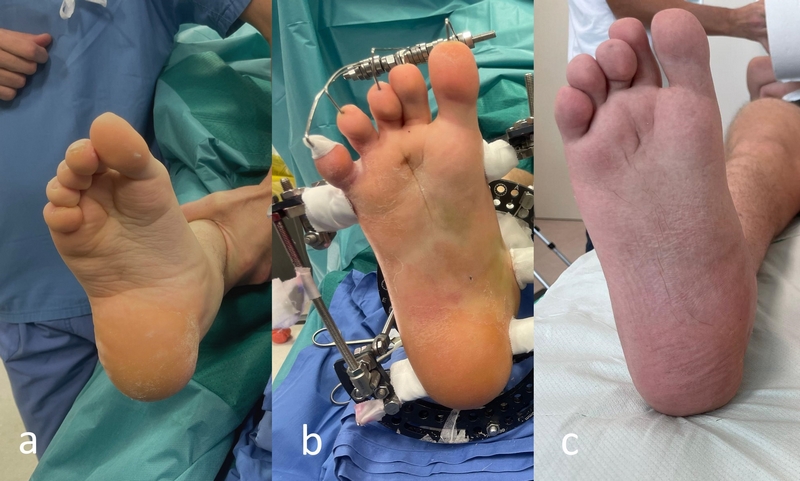
Ilizarov foot: what phases does it consist of?
- Phase 1: Preparatory assessment. Study of the patient’s type, radiographic images, choice of correction and any lengthening to be performed, objectives, and achievement strategies.
- Phase 2: Surgery. A circular external device is applied for foot correction and/or lengthening , with possible bone sectioning if indicated.
- Phase 3: Correction and/or lengthening. The actual correction and lengthening of the anatomical segments begins. This phase is followed both inpatiently and on an outpatient basis with serial check-ups. During this phase, physiotherapy is performed to maintain the limb’s muscle tone and length.
- Phase 4: Bone consolidation phase. Once the correction phase is complete, the foot and, if necessary, the corrected and lengthened “NEW BONE” must be given time to consolidate. At that point, the external device is removed.
- Phase 5: Maintenance. A maintenance period (cast/brace) is generally required to allow the structure to adjust to the new shape once the external appliance is removed.
Ilizarov’s foot: does it cause pain?
The answer is essentially NO. Through modern pharmacological pain management combined with physical and manual therapy, it is possible to contain and reduce painful symptoms after the procedure.
Ilizarov foot: is it a safe procedure?
The answer is YES if the procedure is performed and followed by an expert team. The patient is constantly monitored throughout the various phases and the most modern procedures are applied in each of them to reduce complications to a minimum.
Ilizarov foot: how long does post-operative recovery take?
Just a few days after the operation, the patient can resume normal daily activities.
Ilizarov foot: how long does the treatment course last?
The entire cycle of the various phases of deformity correction lasts approximately 3-4 months.
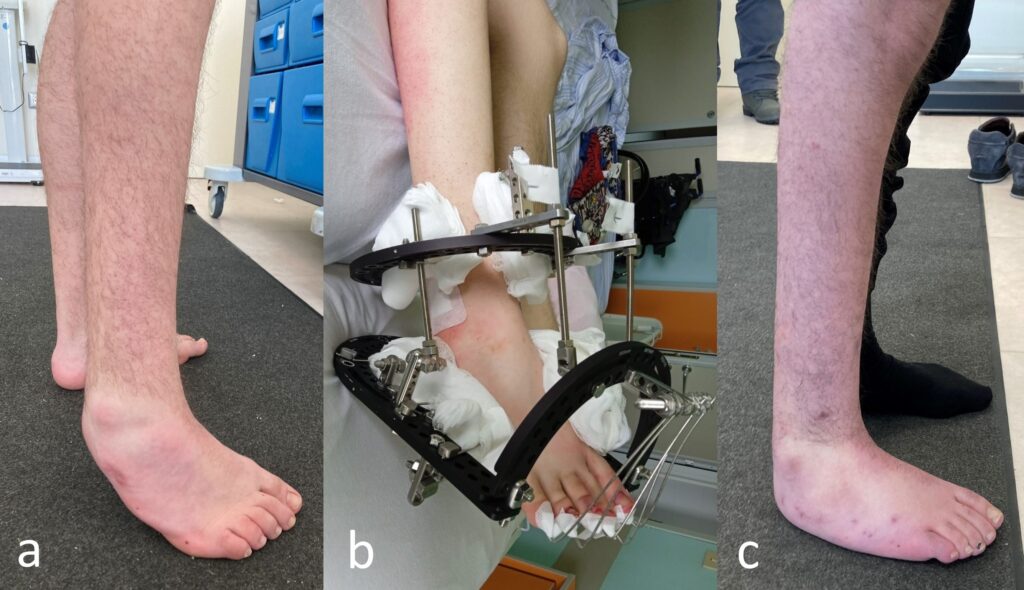
Foot deformity with rigid equinus
Some equine feet have already undergone numerous treatments: several Achilles tenotomies, posterior releases, capsular openings, etc. and are still in equinus.
In these cases, it is useless to schedule other similar procedures, as we sometimes see proposed, even in foreign reference centers.
It’s important to know that there are NO solutions other than the application of an IIZAROV foot apparatus to resolve the problem. The circular external fixator is the most powerful weapon we have and the only one that can correct inveterate equinus deformity.
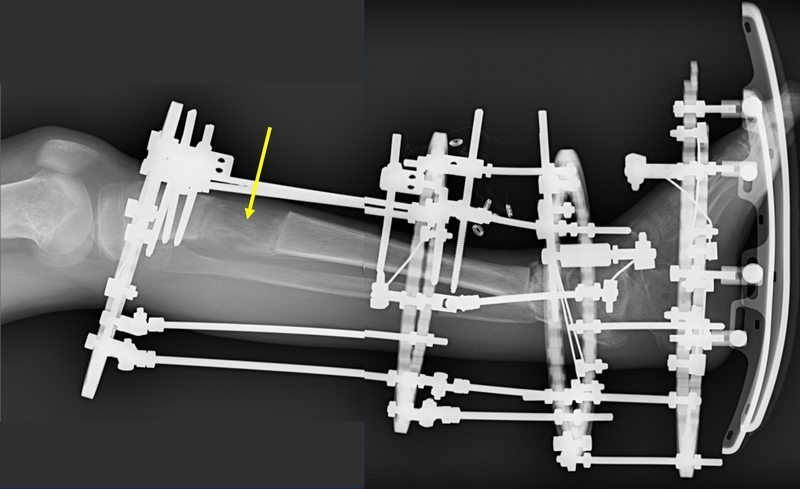
Can it be combined with a leg lengthening?
The answer is YES. In many cases, we treat both the foot deformity and the difference in leg length compared to the contralateral foot. Therefore, we correct both problems in a single procedure .
Is it possible to treat both childhood and adult deformities?
Yes, but clear distinctions must be made and the correct procedures must be applied based on the specific situation. It would be wrong to treat everyone the same.
Patients from abroad: can OrthoChildren Center treat foreign patients?
Yes, many patients come from all countries (Europe and USA):
- the surgical equipe has a wide experience with these proceduresA
- an intensive rehabilitation program can be included
- the procedure is less expensive than in USA and other countries
- Families take advantage of this opportunity to combine a trip to the beauties of Italy