


Toe Walking in Children: Physiological Phase or Cause for Concern?
Toe walking is a fairly common condition in young children, yet it frequently causes understandable concern for parents. Many families request an orthopedic consultation because they notice their child “always walks on tiptoes,” “only walks well when strictly focused,” or “constantly wears out the front of their shoes.”
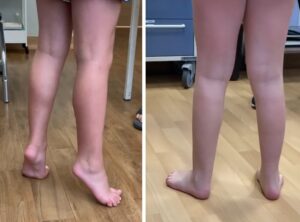
From a clinical standpoint, this condition alters the gait cycle by concentrating the body’s weight predominantly on the forefoot and toes, while the heel receives minimal or no contact. Often referred to as a “dancing gait” due to its resemblance to ballet, true toe walking typically affects both lower limbs symmetrically. Symmetrical presentation helps distinguish it from asymmetric conditions like isolated equinus foot, which point toward different underlying issues.
Children who walk on their toes do not represent a single, homogeneous group. Some show a mild, occasional tendency to push up on their tiptoes when excited or agitated, while others remain on their toes even when standing completely still. Because this condition spans a wide spectrum from simple developmental habits to structural pathologies, consulting specialized centers is essential to get an accurate diagnosis.
When is it considered normal?
A tiptoe gait is very common during the early stages of learning to walk, as toddlers naturally alternate between a normal heel strike and forefoot loading. In most cases, this habit resolves spontaneously with growth, leading to a mature gait pattern by the age of 2. Beyond this milestone, a specialist evaluation is recommended. However, if specific risk factors or red flags are present, investigations should be fast-tracked even before the age of 2 through your pediatrician.
The Main Causes of Toe Walking
When evaluating a child, specialists perform a careful differential diagnosis across three primary clinical categories:
- Neurological Causes: The most common pathological factor, resulting from spasticity or increased muscle tone in the calf. This includes patients with a history of perinatal distress or conditions like Cerebral Palsy. Subtle or borderline cases often require advanced diagnostic imaging, such as a brain MRI.
- Orthopedic Causes: Primary structural issues involve congenital foot deformities where the ankles are fixed in a rigid plantar flexion (equinus deformity) that cannot be passively corrected, sometimes associated with varus or supination deviations.
- Behavioral Disorders: A significant correlation exists between a persistent tiptoe gait and certain neurodevelopmental profiles, such as Autism Spectrum Disorder (ASD), communication disorders, or learning disabilities.
Idiopathic Toe Walking (ITW) and Structural Changes
A large percentage of young patients display no underlying neurological, orthopedic, or behavioral disorders. These children are classified as Idiopathic (or habitual) Toe Walkers. Within this group, patients generally fall into two distinct structural categories:
- Normal Range of Motion: A less frequent subgroup where the child maintains normal ankle flexibility, achieving a physiological passive dorsiflexion.
- Limited Dorsiflexion: A group where the ankle cannot reach a right angle due to severe tightening or shortening of the triceps surae or the Achilles tendon.
Clinical studies suggest that habitual tiptoe walking can lead to progressive tightening over time. In severe cases, surgical findings and specialized MRI scans routinely reveal a distinct structural variation: a very low, distal insertion of the calf muscle fibers directly into the Achilles tendon.
Advanced Treatment Options: Minimally Invasive Surgery
Initial approaches typically prioritize conservative protocols, including specialized physical therapy, serial casting, nighttime braces, or botulinum toxin injections. However, if conservative treatments have not achieved results, it is advisable to consider surgery to protect the joints and restore an efficient gait pattern.
Our minimally invasive approach can guarantee excellent results quickly and without extensive scarring, addressing the underlying tendon tightness while ensuring a smooth, rapid recovery for the child.
Please refer to the specific factsheet, with the answers to many questions:
- Is botulinum toxin effective?
- When to operate?
- which surgery?
- is there a risk of recurrence?
- Can children with autism undergo surgery?