


Daily Life: Holding and Lying Down a Baby with Hip Dysplasia
Holding a baby in a brace and/or cast, especially given the weight it entails, is very tiring. There are some small measures that anyone can do, one of which is the use of a medicine ball . This can be a great ally, helping to support the weight, soothing the baby with a gentle rocking motion, and being much more comfortable than a simple chair, even for the person holding the baby.
An alternative for good support on the bed or sofa is to use a classic breastfeeding pillow, which with its U-shape supports and embraces the little one, keeping him comfortable and safe (always under the strict supervision of an adult, of course).
Alternatively, there are beanbag chairs on the market made of eco-leather or other fabrics, usually padded with polystyrene pellets that allow the body to adapt, guaranteeing comfortable support for the back.

High chairs
When children are a little older and it’s time for feeding, not all high chairs are suitable. It’s advisable to choose a model without side rails and add cushions to make children more comfortable and stable. Some examples of useful models: Chicco Polly Magic, Chicco Polly due Start, Pali Pappy re, Hauck Alpha Plus.

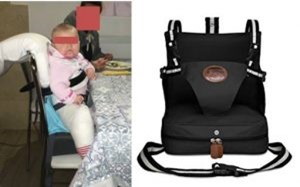
In addition to these, there are risers to place on the chair, equipped with straps . In some cases, the seat can be a bit stiff, but cushions can create some comfort. Safety is a key consideration; sometimes it’s best to develop a system to make the seat even safer. Unfortunately, this is an area where a bit of ingenuity is required, as there are no custom-made accessories.
Car seats
It’s important to avoid carrying your child (with a brace or cast) in your arms when traveling in the car . This practice can be very dangerous in the event of an accident!
On the other hand, it’s important not to remove the spreader in the car . It’s essential that the legs remain spread in the car seat and don’t encounter obstacles such as the sides of the seat itself.
In case of flexed spreaders with little abduction of the limbs, it is still possible to try using your own car seat: for example, by inserting a cushion under the bottom, so that the legs can climb over the sides of the car seat/car seat (but always fastening the seat belts properly).
Alternatively, especially in the case of multi-splitting spreaders (for example the Milgram) or casts, there is a specific item, which can be rented at a fairly low price (against a deposit): this is the BEBE’CONFORT OPAL HD seat , created specifically for children with hip dysplasia .
Unlike normal car seats, which are narrower in the seat, this seat is specifically designed to provide correct back support and greater lateral space for the legs.
This product is not available in any stores but is available online. Information and contact details can be found, for example, on this website: www.doreleurope.com.
It’s advisable to plan ahead as delivery isn’t immediate, but the service is excellent and punctual.

Strollers
As regards transport with the stroller, unfortunately there is no specific article but there are strollers where children can be transported easily, essentially because they are not equipped with side barriers for example: Prenatal Manhattan Model, Maclaren Techno XLR, Chicco Miinimo, Plus Pali, Cybex Eezy Twist, Giordani Viro

Spica cast management and diaper changing
If children are in a cast, things get complicated and prevention and cleaning become essential .
The cast should not get wet with urine or soiled with poop. These precautions are important, as the child cannot be left wearing a smelly, damp cast that can cause irritation.
The measures will vary depending on how large the opening space left by the orthopedist is.
For wider openings and less adherent casts , it will be possible to insert the diaper from below and let it out from above.
For narrower openings and tighter casts , you’ll need two diapers of different sizes . One will be a size smaller than the one your child wore before the cast, and one will be a couple of sizes larger. The larger diaper, which will remain outside the cast, doesn’t need to be changed at every diaper change, only once it’s soiled.
If possible, during the first change in the hospital, it would be useful to cover the opening area in the intimate area with adhesive tape and/or with panty liners , both on the front and back of the torso, so that they protect both the outside of the cast and the inside in contact with the skin.
Take the smaller diaper and cut the tabs on the sides, then tuck the diaper into the hole, making sure it fits snugly and has no creases that could bother the baby or cause sores. Finally, put the larger diaper on top as you normally would.
An important precaution is to change the diaper (inner diaper) frequently to avoid finding it too full and therefore risking something leaking out.
To keep it clean on the outside too, since the classic white cast gets dirty easily, you can buy elastic medical bands (there are also colored ones) that can be replaced when necessary.

Management of braces
Clothing
Even in this case, DIY is very popular, but there is a website where you can find some overalls and trousers created specifically for this need:
https://www.slumbersac.it (e.g. Hip-Pose)

Miscellaneous advice: Skin redness
In any case, whether cast or brace, you need to be careful as the skin could become irritated. At the first sign of redness, it’s a good idea to apply a protective cream, preferably containing zinc oxide as it has a soothing effect.
If you wear a brace, in the leg area, it would be best if the skin was not in close contact with the synthetic parts of the brace, so for example, some tights could be cut and placed as protection on the affected area.

And then finally…free running!
“Even if it seems far away, even if it seems difficult, the day finally comes when you see your child first walking uncertainly, and then running breathlessly, almost as if trying to make up for the time he doesn’t know has been ‘lost’….”

Our center has an outpatient clinic that handles all aspects, from ultrasound diagnosis to the application of braces or casts, to surgical procedures (closed/open reduction, femoral an pelvic osteotomies, etc.)
Please refer to other sheets for specific aspects:
- open reduction
- pelvic and femoral osteotomy
- traction
- osteonecrosis
- the x-rays