


Congenital patellar dislocation is a rare condition in which the patella is dislocated (i.e., not positioned correctly) at birth . This causes impaired knee motion, often associated with a lack of full extension and deviation of the knee’s axis.
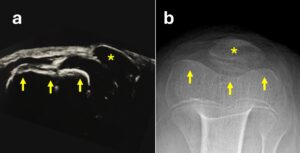
Congenital patellar dislocation is rare and differs from cases in which the patella tends to dislocate at an older age (recurrent patellar dislocation) or following trauma (traumatic patellar dislocation).
In this case, the patella is dislocated from birth and cannot be manually repositioned into its original position.
In some cases this condition is associated with more complex conditions, such as arthrogryposis multiplex congenita (see dedicated fact sheet) or Down syndrome (see).
Congenital patellar dislocation: manifestations
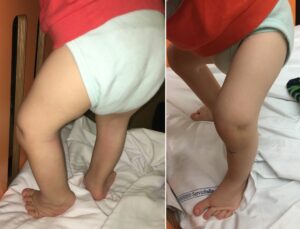
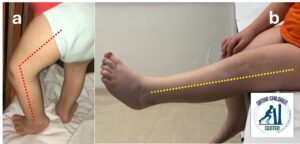
Congenital patellar dislocation presents insidiously. The knee exhibits a more or less pronounced flexion contracture , meaning it cannot be fully extended either passively or actively. The leg appears to be rotated externally with respect to the axis of the femur.
Congenital patellar dislocation: clinical appearance
Congenital patellar dislocation: diagnosis
Congenital patellar dislocation is difficult to diagnose: the diagnosis requires clinical experience, which few centers possess. In many cases, patients have reached this stage after years of follow-up with generic diagnoses of flexion contracture or stiffness, without understanding the exact nature of the problem.
The patella is not ossified in the first years of life, so even radiographic examination cannot fully help in making a diagnosis.
For an exact diagnosis, a correct clinical examination combined with an ultrasound performed by expert hands is necessary.
Congenital patellar dislocation: treatment
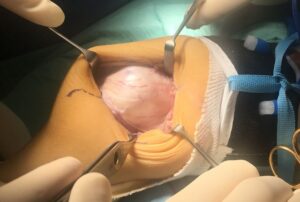
Congenital patellar dislocation requires surgical treatment performed by experienced centers.
The earlier the therapeutic process is started, the better the treatment results are.
Congenital patellar dislocation: our experience
Dr. Lampasi and his team have resolved several cases of congenital patellar dislocation that had not been diagnosed before they came to his attention.