


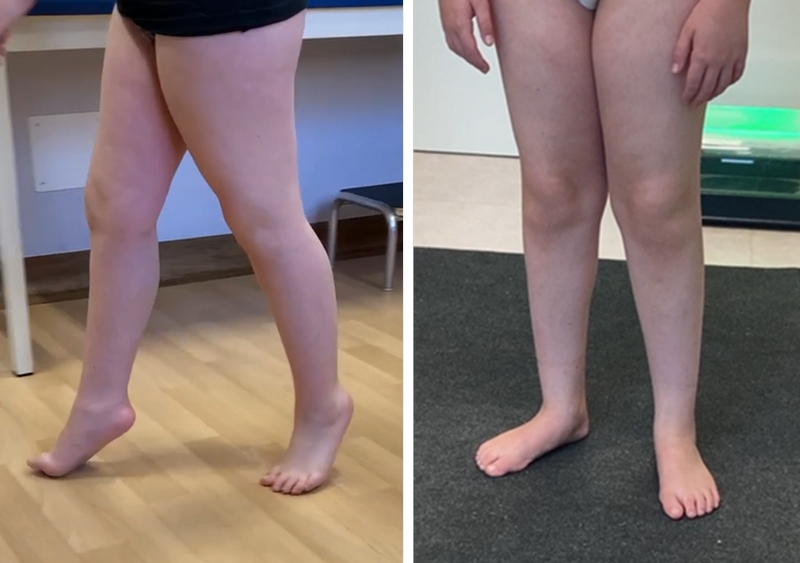
Tiptoe walking is a rather common and very varied condition:
- In many cases it is a transitory phase in the development of walking, which resolves spontaneously, more or less rapidly.
- In other cases, however, it persists, causing secondary problems : these are the cases that require appropriate treatments.
- Finally, some rare cases may hide a more serious problem that requires further investigation and specific treatments.
Toe walking: scientific studies and treatment experience
Dr. Lampasi has been studying the diagnosis and treatment of tiptoe walking for many years, first at the Rizzoli Orthopedic Institute in Bologna, then at Meyer Hospital in Florence (where he was Head of the Neuro-Orthopedics specialistic center). He has conducted several in-depth clinical studies (on neuromuscular aspects, ultrasound aspects, treatment, etc.).
Over the years, Dr. Lampasi and his team, based on the most modern literature and on their experience with various types of treatments, have perfected the treatment of this condition.

Toe walking: an easy diagnosis?
A correct differential diagnosis requires cross-disciplinary experience and expertise, spanning orthopedics and neurology, which few specialized centers possess.
The main risks are underestimating cases that require further diagnostic investigations or, conversely, requesting unnecessary tests.
Toe walking: treatment
There are several treatment options for tiptoe walking:
- simple observation, physiotherapy, botulinum toxin, casts, AFO braces, carbon insoles, night showers, surgery, etc.
Not all treatments have the same indications or efficacy, so it’s important to know how to tailor the treatment to your specific situation.
Based on our years of experience and international scientific research, some of these treatments that were once recommended have been abandoned, while others are proposed more frequently: patients are directed to one type of treatment or another and monitored over time.
Toe walking: Is botulinum toxin effective?
Botulinum toxin is one of the treatments that have been tested in recent years for idiopathic tiptoe walking. The results of this treatment have been largely unsatisfactory, and many guidelines on the subject no longer recommend its use.
Toe walking: when to operate?
There’s no ideal age for surgery. Instead, it’s important to intervene when indicated and at the right time.
In some cases, it is important to intervene early to prevent tiptoe walking from causing secondary alterations. In other cases, it is better to wait.
These are decisions that require experience on the subject.
Toe walking: which surgical procedure is recommended?
Surgical techniques have become much more refined over the years. In the past, invasive procedures were proposed, resulting in long scars and long casts for long periods.
We currently use minimally invasive techniques and microscalpels and the resumption of weight bearing is speeded up.
Tiptoe walking surgery: what results are achieved?
The results of the surgery are very good. Patients who have walked on tiptoe for years, often having already tried all types of treatments (years of physiotherapy, braces, toxin, etc), finally regain the ability to walk with their heels on the ground.
This is an important change from both a functional and social point of view.
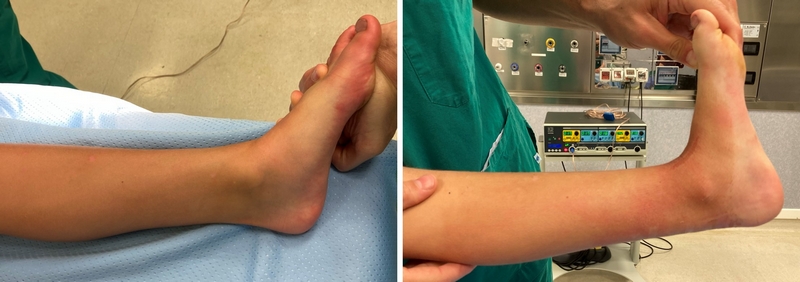
Toe walking: is there a risk of recurrence?
One of the most common fears among families is that the condition may recur (i.e., return) after surgery. This risk can be minimized by following proper instructions and using the correct treatment and postoperative management techniques.
Tiptoe walking in patients with autism: can it be operated on? is there a risk of recurrence?
Over the years, we have treated several patients with autism. In many of these cases, surgery was discouraged due to fear of rapid relapse; however, the results have been good, both functionally and in terms of family satisfaction. However, it is essential that treatment and perioperative management are adequately managed.
Patients from abroad: can OrthoChildren Center treat foreign patients?
Yes, many patients come from all countries (Europe and USA):
- the surgical equipe has a wide experience with these procedures
- an intensive rehabilitation program can be included
- the procedure is less expensive than in USA and other countries
- Families take advantage of this opportunity to combine a trip to the beauties of Italy